… That Lincoln used to observe two New Year’s Days?
It was a problem of calendars. And British stubbornness.
For sixteen centuries, the European world used a calendar set by a decree of Julius Caesar in 46 BCE. The prior Roman calendar had been anchored on the phases of the moon. But for Roman farmers who needed to plant and harvest by the dates of the first and last frosts, the moon cycles had nothing to do with when frosts occurred. Caesar’s new calendar was anchored instead on the phases of the warming sun. This new Julien calendar went into effect on January 1st, 45 BCE, the day of the first new moon following the winter solstice. After that, January 1st would occur every 365 days, with an added day in February every four years.
The problem was, the average Julien year was now 365.25 days long, but the solar year is only 365.2422 days long. As a result, the start of each Julien calendar year on January 1st was out-racing the sun by an extra eleven minutes each year — not by much, but over sixteen centuries, the minutes added up. And for the Catholic Church, the difference increasingly put Easter out of sync with the vernal equinox of the sun.
In October 1582, Pope Gregory XIII set a new calendar for the Church, to realign it with the solar year. The Gregorian calendar did this with a much more complex way of calculating leap years. And it got rid of the extra accumulated minutes by a one-time leap forward of ten days. Thursday, October 4, 1582, was followed by Friday, October 15th. This new calendar was soon adopted by all Roman Catholic countries, and eventually by Protestant countries as well.
But not by the British. The new calendar was just a devious Catholic plot to draw Protestant Britain into acknowledging the authority of the Pope, wasn’t it? In any case, the legal beginning of the new calendar year for Britain was March 25th, so that (for example) March 24, 1749, was followed the next day by March 25, 1750. This produced all manner of confusion, since Scotland legally and the British public by custom regarded January 1st as the start of a new year.
Finally, even the British government had enough. By the Calendar Act of 1751, Parliament in effect adopted the Gregorian calendar for Britain and its colonies (without mentioning Pope Gregory XIII, of course). January 1, 1752, became the legal start of the new year and the new calendar. And the new calendar would be realigned with the sun by leaping ahead eleven days in September 1752.
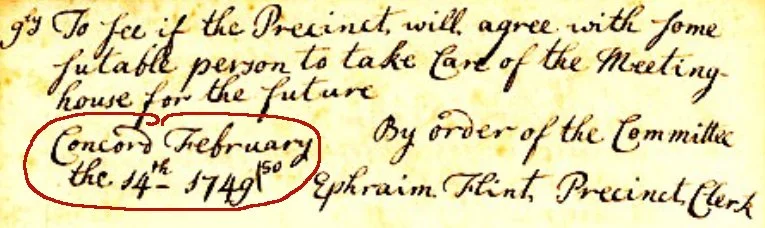
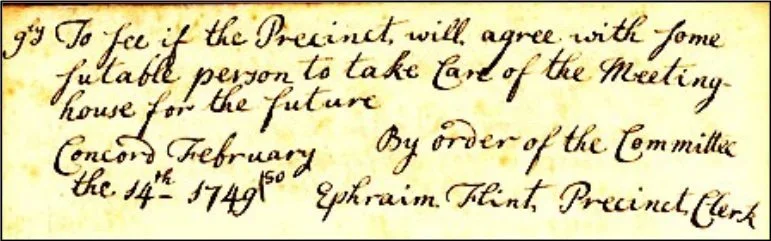
Entry made by Ephraim Flint on February 14, 1749/50
The change made the tasks of town clerks at least a bit easier. Until this change, when a birth, marriage, death, or town transaction fell between January 1st and March 25th, what year were the clerks supposed to write down? The year observed by the public, or the British legal year? Ephraim Flint of Lincoln solved the puzzle by writing both years — February the 14th-1749/50. At last, on January 1st, 1752, such British stubbornness finally came to an end.
Donald L. Hafner
The Lincoln Historical Society
January 2026
To stay “in the know” subscribe & keep informed!
Do you like what you’re reading?
LHS receives no town funding & relies completely on charitable giving.
Consider becoming a Member , Donating , or Volunteering to sustain our work.
Thank you!