… That against all odds, Violet Thayer of Lincoln was a successful businesswoman?
Black History Month is a time to reflect upon stories of Lincoln’s own history of slavery. Here is one such story.
18th century dressmaker’s tools. Elfreth’s Alley Museum, Philadelphia.
Against all odds, Violet Thayer of Lincoln was a successful businesswoman.
When she died in 1813, Violet was in her seventies, and she apparently had never married. Violet’s mother was still alive, but was blind and incapable of managing Violet’s affairs. So John Hartwell, proprietor of the Hartwell tavern, handled Violet’s estate. The probate inventory of Violet’s property included what we might expect of a successful seamstress—two calico gowns, one cambric gown, four short gowns, twenty yards of shirting fabric, thimbles, yarn. In all, the estate was valued at $114. Three more items showed Violet’s success and savvy as a businesswoman. She had $30 in cash, and two loans she had made—one to Bulkley Adams for $20, and the other to Samuel Hartwell for $27.
Violet had died after seven weeks of illness, and during that time, she had been cared for by John and Hepzibah Hartwell. John Hartwell claimed a third of Violet’s estate for his expenses in boarding her during these weeks, but that still left something for Violet’s aged and blind mother.
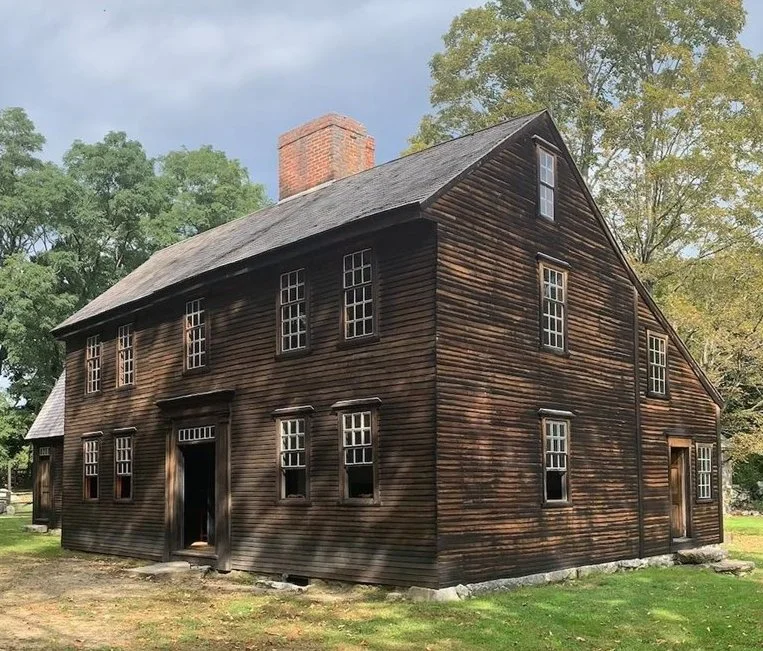
The Hartwell Tavern, Minute Man National Historic Park in Lincoln, Massachusetts
Violet Thayer’s success did not come easily. She had been born into slavery and had been enslaved “from infancy” in the households of Ephraim and Elizabeth Hartwell and then John and Hepzibah Hartwell. Yet at her death, Violet had earned enough money on her own to make loans to two of Lincoln’s prominent citizens. Quite likely, these “loans” were Violet’s shrewd equivalent of a savings account that paid interest, at a time when Lincoln had no banks.
Also against the odds, the Hartwells had attempted to hold Violet in bondage even after the state Supreme Judicial Court had pronounced in 1783 that the court was “fully of the opinion that perpetual servitude can no longer be tolerated in our government.” Essentially, the court gave every “servant for life” in Massachusetts the opportunity to simply walk away from their owners, including the dozen or so slave owners in Lincoln. Yet three years later, when Ephraim Hartwell made out his will in 1786, he included this clause: “I give unto Elizabeth Hartwell my beloved wife … my Negro woman, named Violet for her own service & disposal.”
Ephraim Hartwell died in 1793, and the probate inventory of his estate did not include any mention of Violet among his “property.” Perhaps she had challenged her enslavement; perhaps she had simply been released by the Hartwells. Either way, when freedom finally came to her, Violet Thayer made her own path in the world—and quite successfully.
More stories about Lincoln’s Black residents, enslaved and free, can be found in two books available from the Lincoln Historical Society Bookstore:
Donald L. Hafner’s Entangled Lives, Black and White: The Black Community, Enslaved and Free, in Eighteenth Century Lincoln
John C. MacLean’s A Rich Harvest.
Donald L. Hafner
The Lincoln Historical Society
February 2021
To stay “in the know” subscribe & keep informed!
Do you like what you’re reading?
LHS receives no town funding & relies completely on charitable giving.
Consider becoming a Member , Donating , or Volunteering to sustain our work.
Thank you!